Solo 401(k) Plans for Self-Employed Business Owners
A flexible retirement savings strategy for freelancers, consultants, side-hustlers, and owner-only businesses.
What Is a Solo 401(k)?
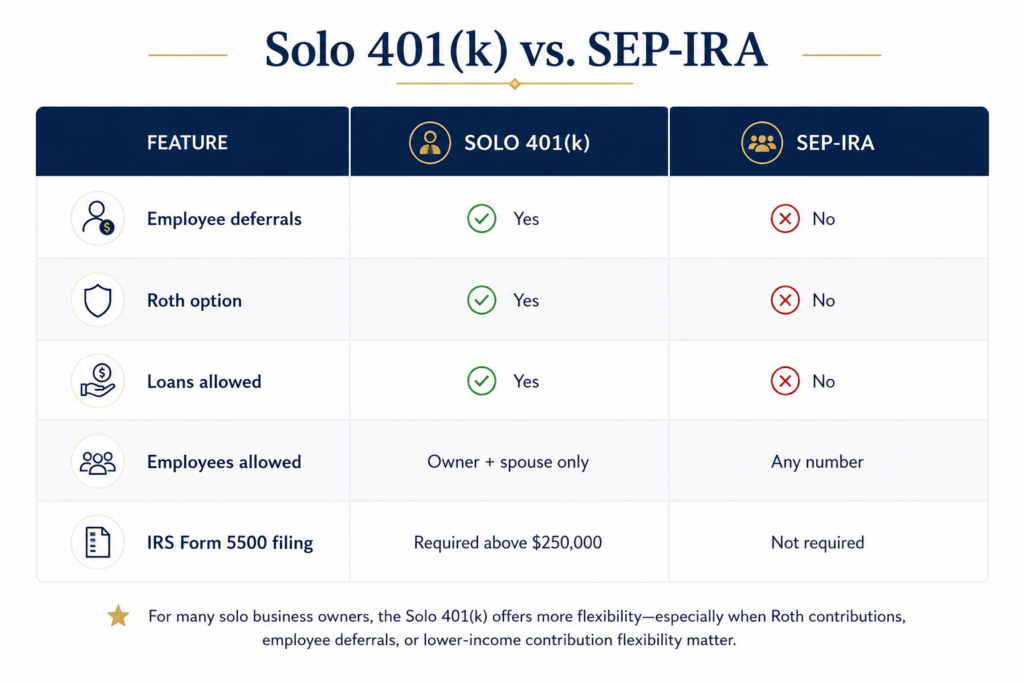
A Solo 401(k), also called an Individual 401(k) or Self-Employed 401(k), is a tax-advantaged retirement plan designed for self-employed individuals and business owners with no full-time employees other than themselves and, optionally, a spouse.
Unlike a traditional IRA, a Solo 401(k) allows you to contribute in two ways: as the employee and as the employer. This can make it one of the most powerful retirement savings tools available to owner-only businesses.
Why Business Owners Choose a Solo 401(k)
Higher Contribution Potential
Eligible individuals may contribute up to $70,000, or $77,500 if age 50 or older.
Roth Options Available
Solo 401(k) plans may allow Roth contributions with no Roth IRA income limits.
Flexible Planning
Spouse contributions, rollover options, and loan provisions may be available depending on the plan design.
Who Is Eligible for a Solo 401(k)?

A Solo 401(k) may be a good fit if you:
F.A.Q.
Contribution Limits and Rules
How much can I contribute to a Solo 401(k)?
In 2026, you can contribute up to $72,000 to a Solo 401(k), or $80,000 to $83,250 if you are 50 or older. Your exact limit is calculated as two separate roles (employee and employer) and is capped by your business’s net earnings.
Example: If your net self-employment income is $100,000, you could contribute $23,500 as an employee deferral plus roughly $18,587 as employer contributions — totaling about $42,087, well above what a SEP-IRA would allow at the same income level.
What is the deadline to open and fund a Solo 401(k)?
To establish the plan: The plan must be opened (paperwork signed) by December 31 of the tax year. This is a hard deadline.
To fund the plan:
– Employee deferrals must be deposited by December 31 of the tax year.
– Employer contributions can be made up to your tax filing deadline, including extensions (typically October 15 for most self-employed filers).
Tip: Don’t wait until year-end to open your plan. Processing can take a week or more, and some custodians close to new applicants in mid-December.
Can my spouse contribute to my Solo 401(k)?
Yes — this is one of the most underutilized features of the Solo 401(k). If your spouse earns compensation from the business, they can make their own contributions under the same plan, effectively doubling the household’s contribution capacity.
Each spouse is treated as a separate participant and each can defer up to $23,500 (plus catch-up) and receive employer contributions based on their own compensation. A couple could potentially contribute over $140,000 in a single year.
Can I make Roth contributions to a Solo 401(k)?
Yes. Roth Solo 401(k) contributions are made with after-tax dollars, but qualified withdrawals in retirement are completely tax-free — including all growth.
Unlike a Roth IRA, there are no income limits for making Roth 401(k) contributions. This makes the Roth Solo 401(k) a powerful planning tool for high-income self-employed individuals who are phased out of direct Roth IRA contributions.
Are there ongoing administrative requirements?
The Solo 401(k) is relatively low-maintenance, but a few requirements apply:
– IRS Form 5500-EZ: Once your plan’s assets exceed $250,000 at year-end, you must file this annual informational return. Failure to file carries penalties of $250/day, up to $150,000.
– Plan document updates: IRS restatement cycles require plan documents to be updated periodically. We handle this automatically.
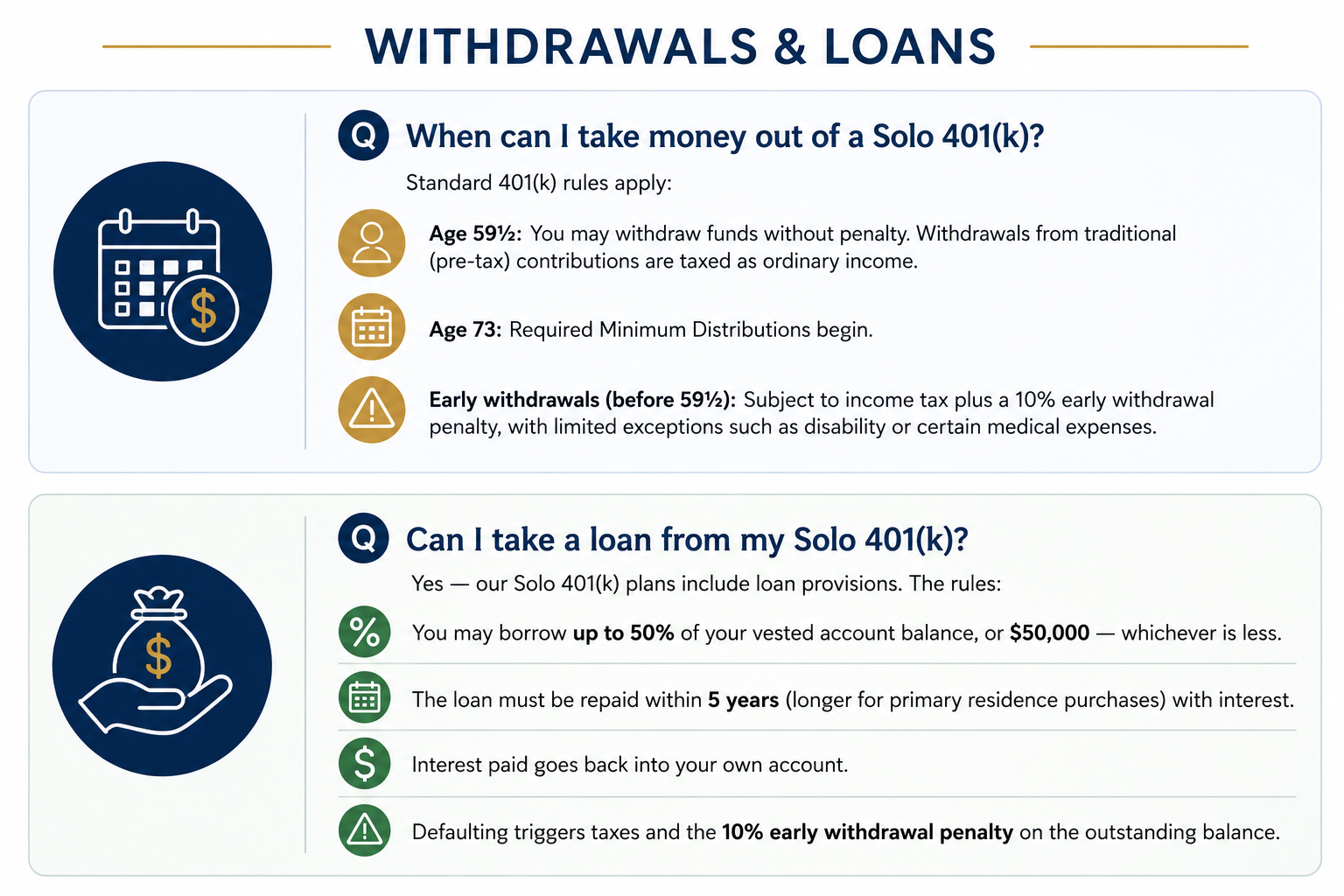
– Required Minimum Distributions (RMDs): Starting at age 73, you must begin taking distributions — same rules as a traditional IRA or 401(k).
Can I roll other retirement accounts into a Solo 401(k)?
Yes. Most Solo 401(k) plans accept rollovers from traditional IRAs (including SEP-IRAs and SIMPLE IRAs), and from prior employer 401(k), 403(b), or 457(b) plans.
Rolling a traditional IRA into a Solo 401(k) can be especially strategic if you want to execute a backdoor Roth IRA conversion without triggering the pro-rata rule, since 401(k) assets are excluded from that calculation.
Tax Strategies
The Solo 401(k) offers significant tax benefits depending on the contribution type:
Traditional (pre-tax): Contributions reduce your taxable income in the year made. Taxes are deferred until withdrawal in retirement, ideally at a lower tax rate.
Roth (after-tax): No upfront deduction, but all qualified withdrawals — including decades of growth — are completely tax-free.
Employer contributions are always pre-tax and deducted as a business expense, reducing both income tax and self-employment tax on that portion.
Does a Solo 401(k) reduce self-employment taxes?
Partially. The employer contribution is deducted as a business expense, which reduces net self-employment income — and therefore the self-employment tax base. The employee deferral portion does not reduce self-employment tax, though it does reduce income tax.
This is one reason the employer contribution is often prioritized for high-income self-employed individuals: it reduces two taxes at once.
Can I have a Solo 401(k) and an IRA at the same time?
Yes. Having a Solo 401(k) does not prevent you from also contributing to a Traditional or Roth IRA, subject to those plans’ own eligibility and income rules. If you’re above Roth IRA income limits, a backdoor Roth IRA strategy may be an option — ask us about how the two plans can work together.
Ready to Maximize Your Retirement Savings?
A Solo 401(k) can be a powerful retirement planning tool for self-employed professionals and small business owners. Altitude Wealth Management can help you evaluate your options, establish the plan, and manage your investment strategy.
Altitude Wealth Management is a fiduciary financial planning and wealth management firm serving Lake Wylie, Clover, York County, and the greater Charlotte area.
 using WordPress and