

I Compared My Coffee Habit to My 401(k)
So You Don’t Have To
A self-inflicted math experiment on the “latte factor” — and why the real problem was never the coffee.
I have a $5.75 oat milk latte most weekday mornings. I’ve heard the lecture before: skip it, invest the difference, retire a millionaire. So I finally sat down and ran the actual numbers on my own coffee habit versus my own 401(k). What I found was more interesting than “stop buying coffee” — and a little less flattering to the finance industry’s favorite parable.
The famous claim, and why it doesn’t hold up
The “latte factor” got popularized in personal finance books that promised skipping a daily coffee and investing the savings could grow into roughly $2 million by retirement. Financial writers who’ve actually run the math have consistently landed somewhere far short of that. One widely cited recalculation, using the same assumptions the original claim relied on, put a more realistic outcome closer to $170,000 — a meaningful sum, but nowhere near “you could have been a millionaire.” Other analyses using a conservative 7% annual return over 40 years land in the $400,000 to $580,000 range, before accounting for taxes, inflation, or the near-certainty that life happens — job changes, medical bills, a kid’s braces — and some of that “saved” money gets spent anyway.
None of this means compound growth isn’t real. It absolutely is. The myth isn’t the math — it’s the implication that a coffee habit is the reason most people aren’t on track for retirement.
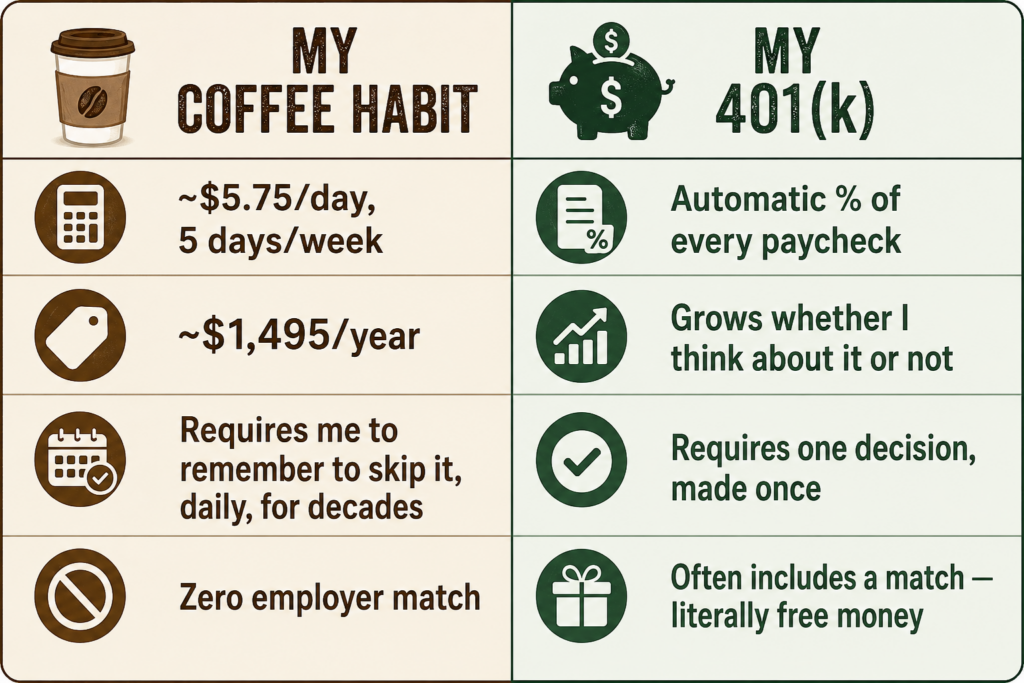
That last row is the whole ballgame. My coffee habit will never match my contribution. My 401(k) does, automatically, every pay period, as long as I’ve opted in. Compared side by side, the coffee isn’t even competing in the same category as the retirement account — one is a small daily choice, the other is a structural, compounding decision that happens whether or not I’m paying attention.
The actual lever that moves the needle isn’t the $5.75 purchase — it’s the percentage of income going into a retirement account, whether that percentage increases with raises, and whether an employer match is being fully captured. Those three levers will outperform a decade of latte abstinence every time.
Why the myth is so sticky anyway
The latte factor persists because it’s simple, visual, and makes saving feel achievable in a small, daily way instead of an abstract, distant goal. There’s real value in that — building any small savings habit is good practice, and awareness of daily spending isn’t a bad thing. The problem is when it becomes the whole strategy, or worse, a source of guilt that distracts from bigger, more consequential financial decisions: how much of a paycheck is actually being saved, whether that savings rate increases over time, and whether an employer match is being left on the table.
If someone is working full-time and still can’t cover essentials, the answer isn’t fewer lattes — it’s a harder look at income, debt structure, or a conversation with a professional about what’s actually driving the gap.
So: I’m keeping the latte. I’m also keeping my 401(k) contribution exactly where it is, because it turns out that decision was doing all the heavy lifting the whole time.
This material is for general information and educational purposes only and is not intended to provide specific advice or recommendations for any individual. Investing involves risk including the loss of principal. There is no assurance that the views or strategies discussed are suitable for all investors or will yield positive outcomes.
 using WordPress and
Comments are closed