
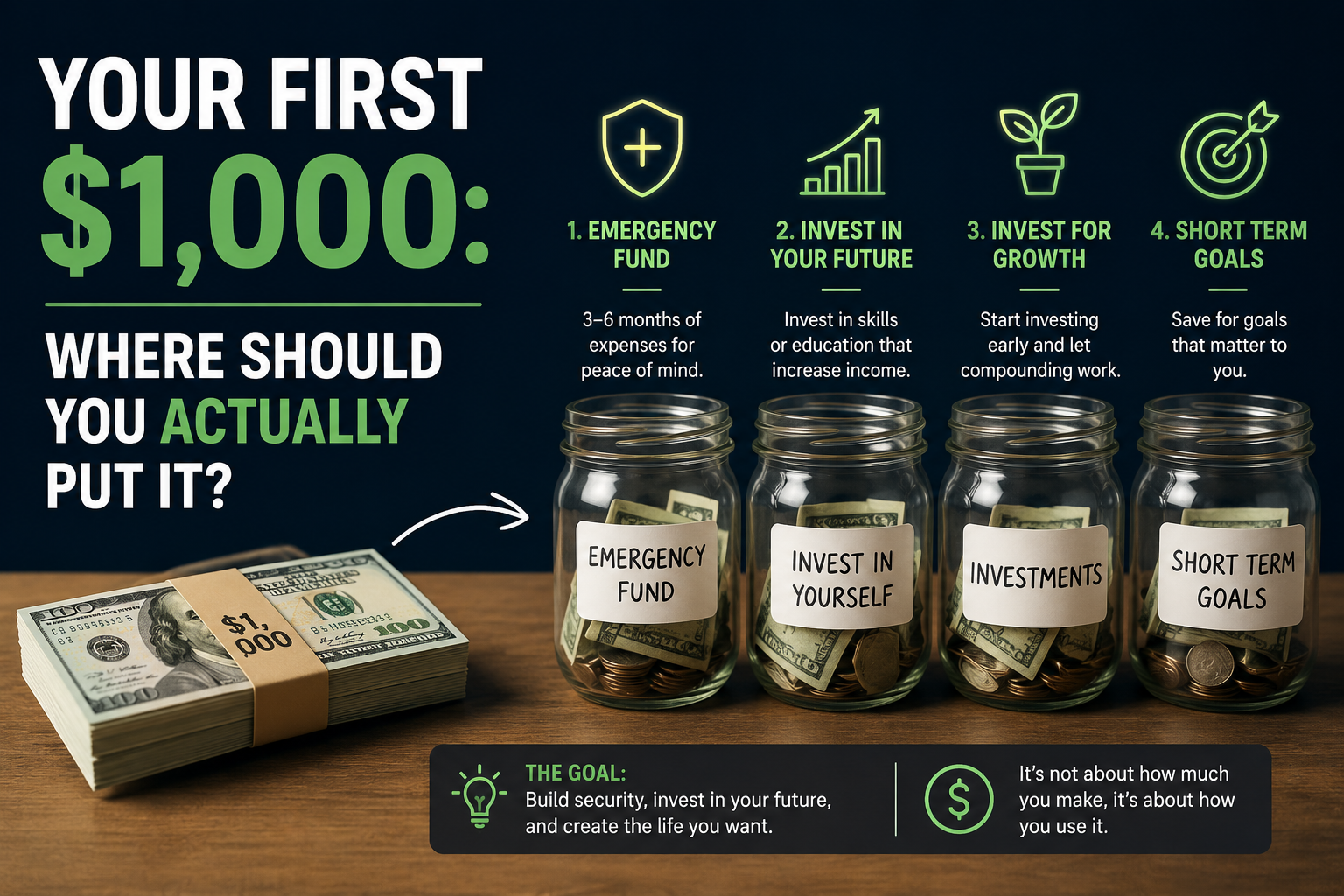
Your First $1,000: Where Should You Actually Put It?
You’ve saved your first thousand dollars. That’s a real milestone — now let’s make sure it works as hard as you do.
Saving your first $1,000 is no small feat. Whether it came from side hustle income, cutting back on subscriptions, or finally getting serious about setting money aside each paycheck — you’ve done something most people put off for years. Now comes the question everyone Googles at 11pm: what do I actually do with it?
The honest answer is: it depends. But here’s a clear, practical breakdown of your best options — and how to think about which one is right for you right now.
Step One: Do You Have an Emergency Fund?
Before you invest a single dollar, ask yourself: if your car broke down tomorrow, or you had an unexpected medical bill, could you cover it without going into debt?
If not, your first $1,000 belongs in a high-yield savings account (HYSA) — not the stock market. The goal of an emergency fund is stability, not growth. You want this money available instantly, without worrying about market timing.
A good rule of thumb: aim for 3–6 months of living expenses in your emergency fund before putting money into investments. Your first $1,000 is a great start toward that goal.
If Your Emergency Fund Is Covered, Here Are Your Options
Best for most beginners
Contribute to a Roth IRA
A Roth IRA is one of the most powerful tools available to young investors. You contribute money that’s already been taxed, it grows tax-free, and you pay nothing in taxes when you withdraw it in retirement. With a $1,000 initial contribution, you can get started immediately through most major brokerages. The 2024 contribution limit is $7,000 per year — and the earlier you start, the more time your money has to grow.
If your employer matches
Max Out Your 401(k) Match First
If your employer offers a 401(k) match — say, they match 3% of your salary — contribute at least enough to capture the full match before doing anything else. That match is an immediate 50–100% return on your money, which nothing else can beat. Use your $1,000 to give yourself a buffer while you redirect a portion of each paycheck toward hitting that match threshold.
Simple, low-cost investing
Index Funds in a Brokerage Account
If you’ve handled your emergency fund and are already contributing to a retirement account, a low-cost index fund in a standard brokerage account is a solid next step. Index funds track the broader market (like the S&P 500), require minimal management, and have historically delivered strong long-term returns. Many allow you to start with as little as $1.
Before investing
Pay Off High-Interest Debt
If you’re carrying credit card debt at 20%+ interest, paying it down is effectively a guaranteed 20%+ return — better than almost any investment. Your $1,000 might be better spent eliminating that balance than entering the market. Once high-interest debt is gone, investing becomes much more powerful.
The Bottom Line
There’s no single “right” answer, but there is a smart order of operations:
1. Build your emergency fund first (3–6 months of expenses).
2. Eliminate high-interest debt.
3. Capture your employer’s 401(k) match.
4. Open and contribute to a Roth IRA.
5. Invest additional savings in a brokerage account.
Your first $1,000 might go entirely toward step one — and that’s a completely sound decision. Building a financial foundation isn’t glamorous, but it’s what makes everything else possible.
The most important thing? Start. The investors who build real wealth aren’t the ones who waited for the “perfect” moment — they’re the ones who began with what they had.
This material is for general information and educational purposes only and is not intended to provide specific advice or recommendations for any individual. Investing involves risk including the loss of principal. There is no assurance that the views or strategies discussed are suitable for all investors or will yield positive outcomes.
 using WordPress and
Comments are closed